Choosing the right Content Management System (CMS) in 2026 feels a bit like choosing a car in the era of electric vehicles and autonomous driving. The basics remain the same, you need to get from point A to point B, but the technology under the hood has become incredibly sophisticated. WordPress and Joomla have been the “Ford and Chevy” of the web for two decades, but as we move deeper into 2026, the gap between their philosophies has widened even as their capabilities have grown.
If you’re staring at a blank screen trying to decide where to click “Install,” you aren’t just choosing a piece of software; you’re choosing a workflow that you’ll live with for years. Let’s break down how these two titans stack up in the current digital landscape.
How the Web Changed by 2026
Content management isn’t just about text and images anymore. In 2026, SEO is driven by “Experience Signals,” AI-driven search bots, and lightning-fast performance. Both WordPress and Joomla have had to evolve. WordPress has leaned heavily into the “Site Editor” (formerly Gutenberg) to compete with “no-code” builders, while Joomla has doubled down on being the most stable, developer-friendly open-source framework for complex data.
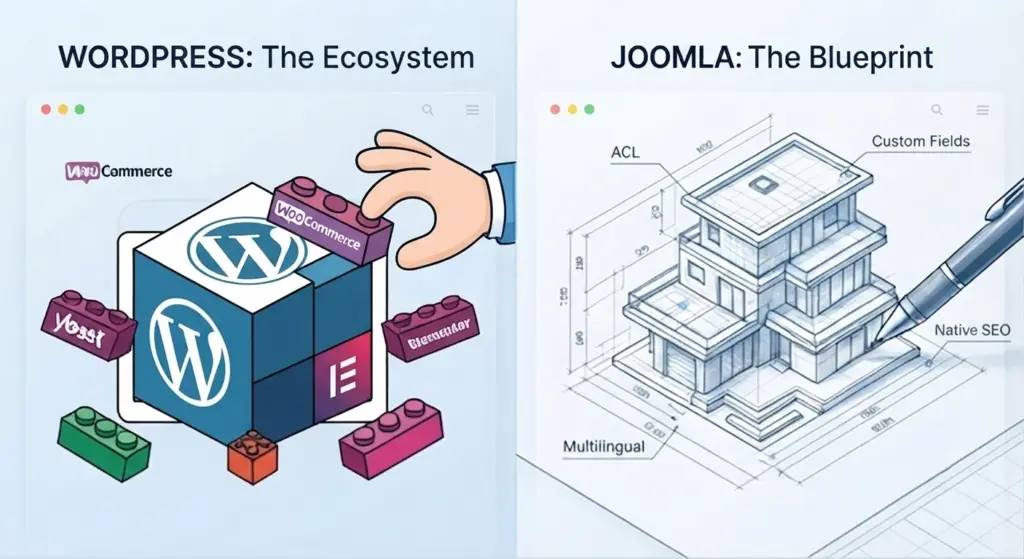
1. Understanding the Core Philosophy: Legos vs. Blueprints
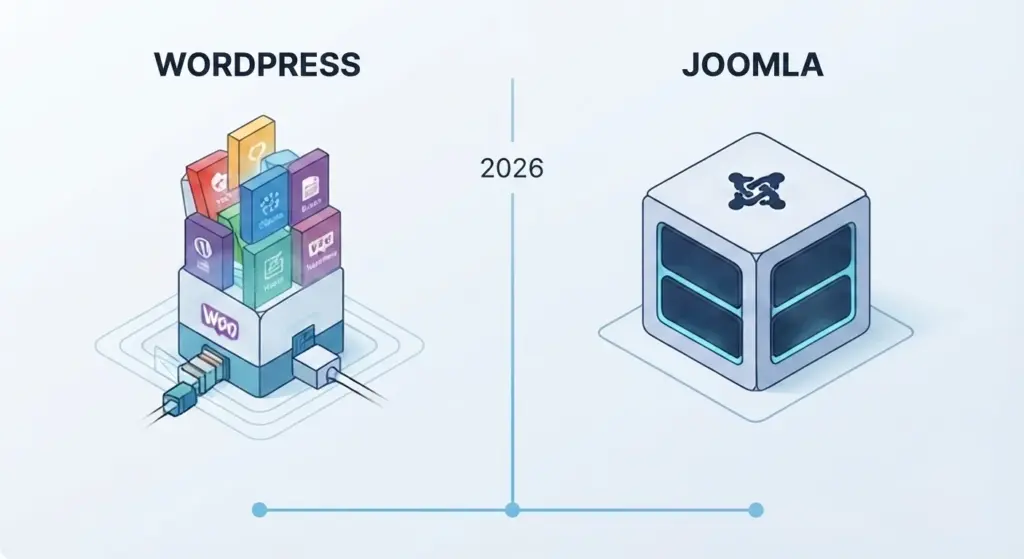
To get why these platforms feel so different, you have to look at what they want to be when they grow up.
The WordPress Mantra: Accessibility Above All
WordPress operates on the “Democratization of Publishing.” Their goal is to make it so that a baker in Paris or a tech startup in Austin can get a site running in twenty minutes. It’s built on a “Core + Plugins” model. The core software is kept relatively light, assuming that you will go to the massive marketplace to find the specific “blocks” you need.
The Joomla Mantra: Architecture and Precision
Joomla sits in a more “professional” tier. It’s often described as a “Content Management Framework” rather than just a CMS. Joomla assumes you aren’t just building a blog; you’re building a system. It provides a more robust set of tools out of the box, like advanced user permissions and multi-language support, without requiring you to go hunting for third-party add-ons.
2. Ease of Use: The First 48 Hours
The “learning curve” is the most cited reason people pick one over the other.
The WordPress Experience: The Visual Revolution
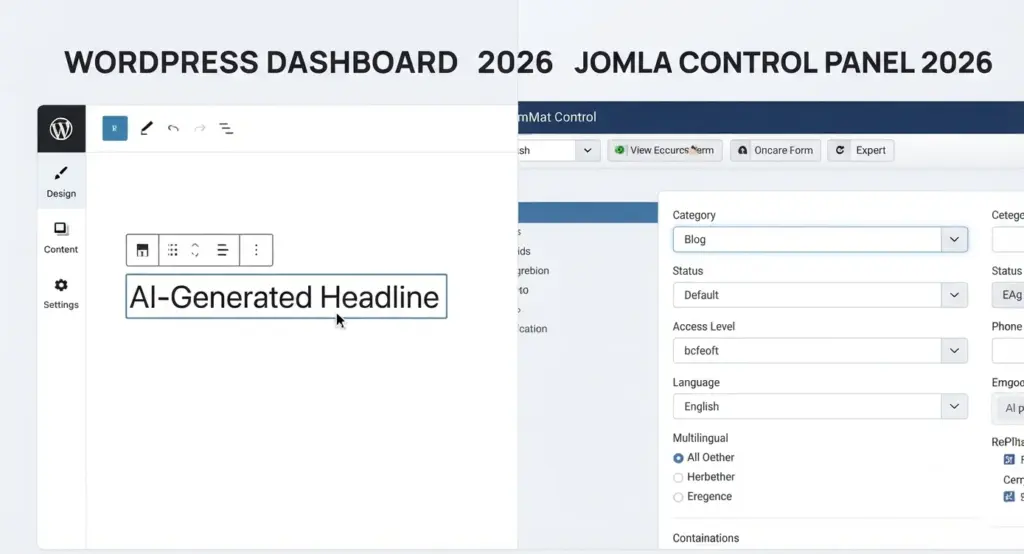
By 2026, WordPress is almost entirely a visual experience. The Block Editor has matured to the point where “What You See Is What You Get” (WYSIWYG) is actually true.
- The Dashboard: It remains friendly and familiar. Even if you haven’t touched a website since 2015, you’ll find your way around the sidebar in minutes.
- Onboarding: Because it powers roughly 43% of the internet, every question you have has already been answered on a forum or in a YouTube video.
The Joomla Experience: The Power User’s Dashboard
Joomla isn’t “harder,” but it is more “technical.” It uses terminology that reflects a deeper understanding of web architecture.
- The Structure: In WordPress, you just write. In Joomla, you’re encouraged to think: “Is this an Article? Which Category does it fit? Which Menu item does it link to? Who has permission to see it?”
- The Admin UI: The backend in 2026 is much cleaner than the cluttered menus of the past, but it still requires a “manual-first” approach. You’ll want to read the documentation before you start clicking.
3. Customization: How You Build Your Vision
This is where the rubber meets the road. How do you actually turn a template into a unique brand?
WordPress: The Power of the Ecosystem
The WordPress Plugin Directory is the largest collection of free software on the planet.
- Growth Potential: You can start as a blog and, with three clicks, become a global e-commerce store using WooCommerce.
- The “Plugin Trap”: The danger in 2026 remains “plugin bloat.” It’s tempting to install 40 plugins to solve 40 small problems, but this can lead to security holes and slow loading times.
Joomla: The Built-In Advantage
Joomla’s philosophy is “Do more with the core.”
- Native Custom Fields: While WordPress often requires a plugin (like ACF) to handle complex data types, Joomla has robust custom fields built right into the core.
- Search and Filters: Joomla’s internal search and tagging systems are much more powerful out of the box, making it better for directory-style sites or large resource libraries.
4. SEO in 2026: Winning the Search Game
In 2026, SEO isn’t just about keywords; it’s about Core Web Vitals, schema markup, and “Search Generative Experience” (SGE) readiness.
How WordPress Handles SEO
WordPress is “SEO-friendly” mainly because of its community. Plugins like Yoast or RankMath are industry standards that hold your hand through the process.
- The Edge: Because so many developers focus on WordPress, it often gets the latest SEO tech (like automatic schema generation for AI bots) first.
- The Downside: If you use a heavy theme and too many plugins, your “Largest Contentful Paint” (LCP) score will tank, which hurts your ranking.
How Joomla Handles SEO
Joomla has moved most of its SEO tools into the core software.
- Clean Code: Historically, Joomla has been praised for producing cleaner HTML out of the box, which search engines love.
- URL Management: Joomla gives you much tighter control over your URL structures and redirects without needing an extra plugin. This “lean” approach often results in faster speeds, which is a major ranking factor in 2026.
5. Multilingual Sites: A Global Presence
If you need your site to speak English, Spanish, and Arabic, the choice becomes much clearer.
The Joomla Masterclass
Joomla was built for a global audience. Multi-language support is a core feature. You can translate every single element, from the menus to the modules to the articles, without buying a single “Pro” extension. It handles right-to-left (RTL) languages flawlessly.
The WordPress Workaround
While WordPress can do multi-lingual, it usually requires a heavy-duty plugin like WPML or Polylang. These are excellent, but they add a layer of complexity and often a recurring cost to your project. If your primary goal is a 10-language corporate portal, Joomla is the undisputed king.

6. Security: Protecting Your Digital Property
No site is unhackable, but the way these two platforms handle threats is a study in contrasts.
The “Target” Factor of WordPress
Because WordPress is everywhere, it is the most targeted CMS in the world. Most breaches happen because of:
- Outdated plugins.
- Weak passwords.
- Cheap, unmanaged hosting.
WordPress has a world-class security team, but the “open” nature of the plugin market means you have to be your own digital bodyguard.
The “Security by Design” of Joomla
Joomla includes features like Multi-Factor Authentication (MFA) and “Security Check” tools directly in the admin panel.
- Stability: Because you need fewer third-party extensions to run a Joomla site, there are fewer “back doors” for hackers to exploit.
- ACL (Access Control List): Joomla’s permission system is incredibly granular. You can give a user permission to edit one specific category of articles without giving them access to anything else. This makes it much safer for large teams.
7. Performance and Speed: The 2026 Standard
By 2026, a site that takes longer than two seconds to load is effectively invisible.
- WordPress: Speed is highly variable. A optimized WordPress site on a LiteSpeed server is a Ferrari. A bloated one on budget hosting is a tricycle with a flat tire. You have to be intentional about performance.
- Joomla: It tends to be faster “out of the box.” Its caching system is more sophisticated and integrated into the core, meaning even a novice can achieve decent speeds without being a server expert.
8. The Cost Question: Free vs. Real-World Expenses
While both pieces of software are free (Open Source), the “total cost of ownership” differs.
- WordPress: You’ll likely spend more on “Pro” versions of plugins and premium themes. However, because the market is so competitive, you can find developers at every price point.
- Joomla: You might spend less on extensions because the core does so much. However, because there are fewer Joomla developers than WordPress ones, hiring an expert for a custom job can sometimes be more expensive per hour.
9. Which One Should You Choose? (The “Smart Friend” Verdict)
There is no “better” CMS, only a better fit for your specific vision.
Choose WordPress if:
- Timelines are tight: You need a high-quality site live by Monday.
- You’re a solo creator: You want to manage everything yourself without learning code.
- Content is your focus: You’re running a blog, a magazine, or a simple business site.
- You want infinite options: You love browsing themes and trying out new features every week.
Choose Joomla if:
- You’re building a “System”: You’re creating a member portal, a complex directory, or a social network.
- You need “Enterprise” features: You need complex user permissions and native multi-lingual support.
- You value stability over “shiny” features: You want a site that feels cohesive and “built-in” rather than “bolted-together.”
- You’re a technical enthusiast: You enjoy understanding how the gears of your website turn.
Final Thoughts: The Web is 2026 and Beyond
In 2026, the distinction between “Simple WordPress” and “Complex Joomla” is starting to blur as both platforms adopt more modern technologies like headless APIs and AI-assisted content generation.
Ultimately, WordPress is for those who want to move fast and break things (in a good way) within a massive community. Joomla is for those who want to measure twice and cut once, building a sturdy architectural masterpiece.