The best landing page examples all do one thing extremely well: they make a single, specific offer incredibly easy to say “yes” to while removing every possible doubt or friction point. If you model your pages on proven examples—then layer in your own data, messaging, and branding—you can reliably turn more visitors into qualified leads or paying customers.
What Makes a “Best” Landing Page in 2026?
The strongest landing pages share a common architecture that consistently drives conversions across SaaS, e‑commerce, and service businesses.
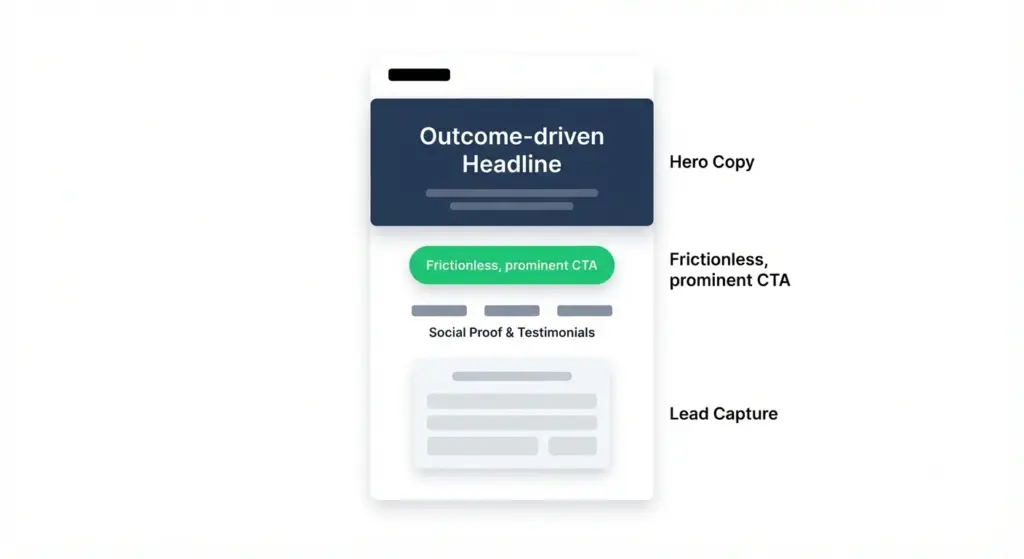
- One page, one goal: Every element supports a single conversion event (demo request, lead form, purchase, webinar signup).
- Clear, outcome‑driven headline: The hero copy focuses on how the user’s life improves, not just on product features.
- Frictionless, prominent CTA: Buttons are visually obvious, repeated down the page, and use specific, action‑oriented language.
- Strong social proof: Testimonials, case metrics, logos, and trust badges validate your promise above and below the fold.
- Fast, mobile‑first experience: Slow or clunky layouts quietly erode trust and hurt conversion rates, especially on mobile.
You can plug your own portfolio metrics into each of these elements (e.g., “Increased lead quality by X%” or “Reduced acquisition costs by Y%”) to turn a good landing page into a persuasive sales asset for decision‑makers.
7 Best Landing Page Examples (And Why They Work)
Below are categories of best landing page examples you can emulate, along with what they typically do right. Insert a real page from your swipe file or agency work into each archetype to make this article fully original.
1. SaaS Free Trial Landing Page
A high‑performing SaaS trial page focuses on getting the user into the product with as little friction as possible.
Key traits:
- Outcome‑centric hero: The headline clearly states the transformation (e.g., “Ship projects on time without 3‑hour planning meetings”).
- Simple signup form: Often just email + password or SSO; upsell details are deferred until after onboarding.
- Product‑led visuals: Screenshots or short clips show the interface solving a concrete business problem.
- Specific social proof: Quantified testimonials like “Cut onboarding time from 4 days to 6 hours” beat generic praise.
From your agency’s perspective, this is an ideal place to showcase metrics like trial‑to‑paid conversion rate improvements after redesign.
2. Lead Generation / B2B Service Landing Page
For agencies, consultants, and B2B services, the landing page’s job is to start a qualified conversation, not close the entire deal.
Key traits:
- Single, primary CTA: “Request a strategy call” or “Get a free audit” repeated down the page without competing actions.
- Problem‑solution narrative: Brief copy that mirrors the visitor’s pain (e.g., “low quality leads,” “slow dev cycles”) and shows a clear remedy.
- Authority signals: Case study snippets, recognizable logos, and short expert bios build credibility.
- Light, focused form: A few targeted fields (budget range, role, timeline) filter leads without killing completion rates.
Here you can reference an internal case like “After implementing this layout, our client’s booked calls increased by X% in Y months.”
3. E‑Commerce Product Launch Landing Page
Launch or seasonal campaign pages combine storytelling with a direct purchase path.
Key traits:
- Story‑driven hero: A narrative or hook (launch, scarcity, or innovation) captured in the headline and subheading.
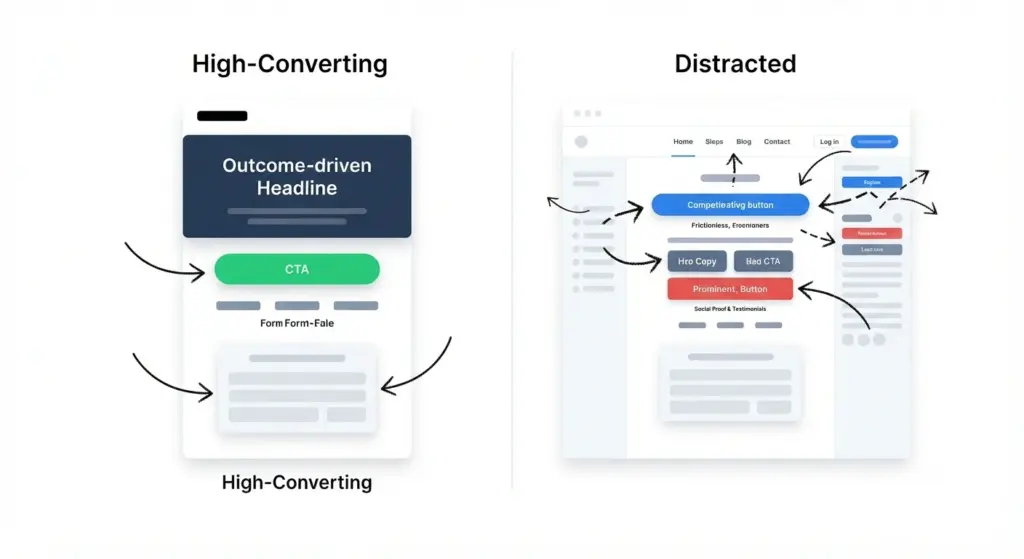
- Zero‑distraction layout: No navigation; all roads lead to “Add to cart” or “Pre‑order.”
- Visual hierarchy: Large product imagery, supporting lifestyle photos, and clear pricing near the CTA.
- Trust reinforcement: Shipping info, returns policy, and reviews placed close to the buy button.
Your portfolio metrics can highlight outcomes like higher average order value or improved launch‑day revenue after adopting this structure.
4. Webinar / Event Registration Landing Page
Webinar and event pages are among the best landing page examples for list growth and lead nurturing.
Key traits:
- Value‑first headline: Emphasizes what the attendee will learn or achieve (e.g., “Cut deployment time by 50%”).
- Agenda snapshot: Bulleted learning outcomes help busy professionals quickly judge relevance.
- Speaker credibility: Photos, roles, and micro‑bios reassure visitors this isn’t a generic pitch.
- Time‑sensitive CTA: “Save my seat” or “Reserve my spot” tied to a clear date and time. To make this section concrete, you can insert your own webinar page, including attendance rate improvements after optimizing messaging and forms.
5. Free Resource / Download Landing Page
Templates, checklists, or whitepapers build your email list while demonstrating expertise.
Key traits:
- Offer clarity in one glance: Title and hero text explain exactly what the resource is and who it’s for.
- Benefit bullets: A short list describing how the resource solves a specific problem or saves time.
- Form tuned to intent: More fields (role, company size) are acceptable when the perceived value is high.
- Post‑opt‑in expectation setting: Small note about what happens after signup (e.g., “You’ll also receive a monthly insights email”).
This is a perfect place to anchor statistics like “Increased MQL volume by X% after launching this downloadable resource funnel.”
6. Productized Service / Fixed‑Price Offer Landing Page
Productized offers (e.g., “Landing Page in 10 Days” or “Technical SEO Cleanup”) convert especially well with a purpose‑built landing page. Key traits:
- Crystal‑clear scope: Exactly what’s included, what’s excluded, and what the deliverables look like.
- Step‑by‑step process: A simple, visualized workflow reassures prospects about how work will happen.
- Transparent pricing: Fixed or tiered pricing with a clear comparison of value per package.
- FAQ block: Addresses objections around timing, revisions, tech stack, and communication upfront.
Here you can plug in concrete outcomes like reduced sales cycle length or higher close rates for specific service packages.
7. “Coming Soon” / Pre‑Launch Landing Page
Pre‑launch pages are minimal but powerful lead‑capture tools when done right.
Key traits:
- Curiosity with clarity: Short headline that hints at the solution without being vague.
- Single email field: Very lean form asking only for contact info, sometimes with an optional role or company field.
- Social proof or founder note: A short message from the founder or an early testimonial can build trust.
- Light engagement hook: “Get early access,” “Join the beta,” or “Be first to know when we launch.”
You can pair these with metrics like “Captured X pre‑launch signups that converted at Y% on launch day.”
Structural Ingredients of High‑Performing Landing Pages
Beyond individual examples, there are structural components that nearly all best landing page examples share.
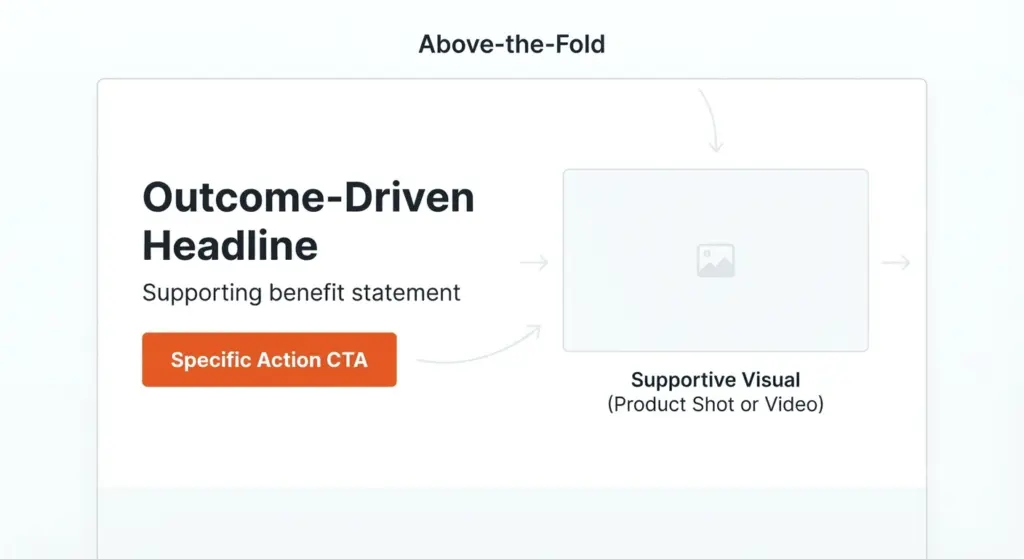
Above‑the‑Fold: Your 5‑Second Pitch
Most visitors decide whether to stay or leave within a few seconds. Core elements:
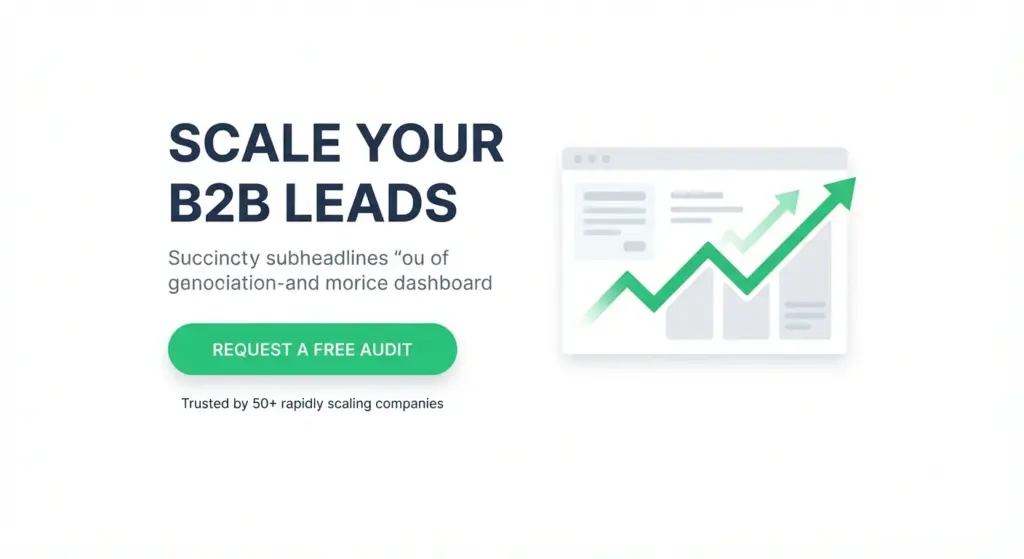
- Outcome‑driven headline and subheadline: Immediately explain who the page is for and why they should care.
- Primary CTA with specific copy: “Start my free audit,” “See my score,” or “Get the template” generally outperforms vague CTAs.
- Supportive visual: Screenshot, hero illustration, or product photo that reinforces the headline’s promise.
- Micro social proof: A short line such as “Trusted by X+ businesses” or “Joined by Y founders” right near the CTA.
This is where you can embed your agency’s strongest portfolio stat—for instance, total conversions or clients served—without sounding promotional.
Mid‑Page: Objection Handling and Proof
The middle of the page builds the logic and trust required for a decision.
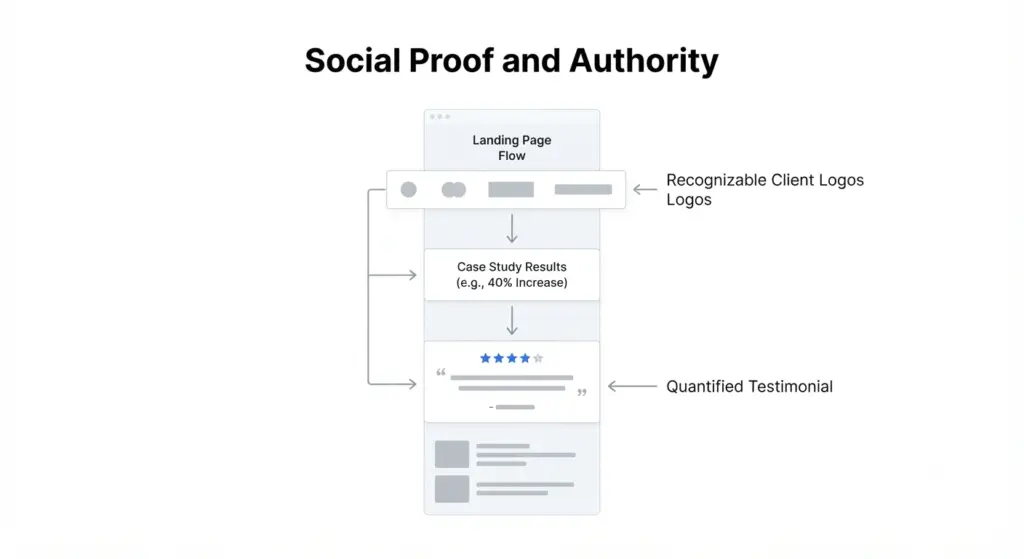
Key elements:
- Pain‑point sections: Short blocks that articulate the visitor’s challenges and how your solution directly addresses them.
- Feature‑benefit mapping: Each feature is paired with a tangible business benefit (time savings, cost reduction, risk mitigation).
- Social proof depth: Case snapshots with metrics, role‑specific testimonials, and short stories of transformation.
- Visual hierarchy: Headlines, icons, and contrast keep the page easy to scan and understand quickly.
Here you can systematically weave in your agency’s metrics such as “Reduced page load time by X seconds” or “Improved conversion rate from A% to B%.”
Bottom of the Page: Risk Removal
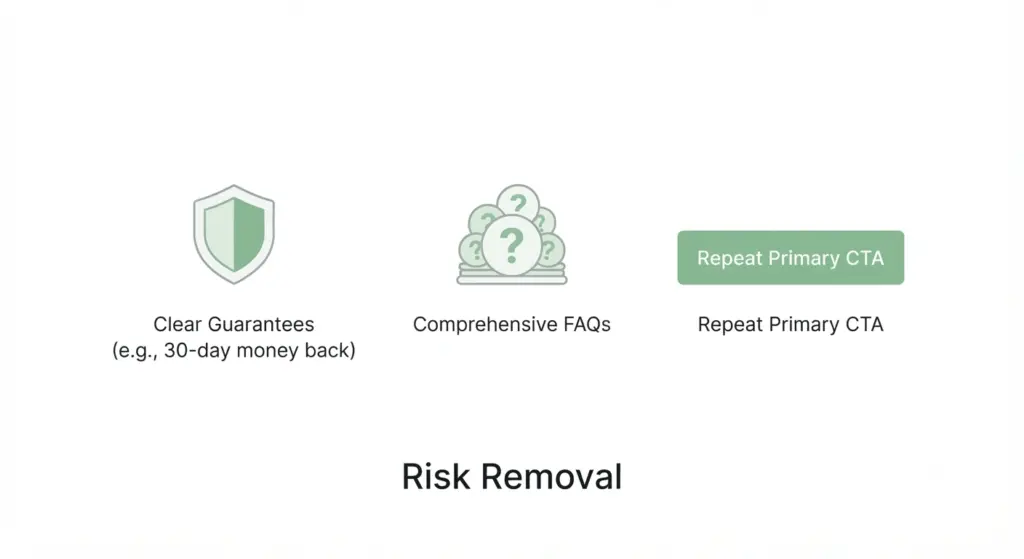
The final third of a best‑practice landing page reduces perceived risk and nudges hesitant visitors to act.
Key elements:
- Guarantees and assurances: Satisfaction notes, cancellation terms, or “no credit card required” messages.
- Final CTA with recap: Summarizes the value and repeats the main action request in simple language.
- FAQ section: Addresses typical objections around price, process, data privacy, support, and timelines.
- Contact or support nudge: A subtle prompt to reach out if visitors still have questions.
Technical service agencies can also include reassurance about stack compatibility, security practices, and compliance standards in this area.
Technical Optimization: Why Design Isn’t Enough
A landing page that “looks great” but performs poorly on a technical level will almost never become a best‑in‑class example.
Performance and Core Web Vitals
Modern landing pages must be fast and stable on all devices.
Focus areas:
- Optimized assets: Compressed images, lean video usage, and modern formats like WebP to keep load times low.
- Minimal blocking scripts: Reduced third‑party tags and deferred loading where possible.
- Responsive layout:** Mobile‑first design that preserves hierarchy and CTA clarity on smaller screens.
- Accessibility basics: Sufficient contrast, alt text, keyboard navigation, and logical heading structure. You can reference internal improvements like “After optimizing assets, mobile conversion rate increased by X%” as proof of impact.
Conversion Optimization and Testing
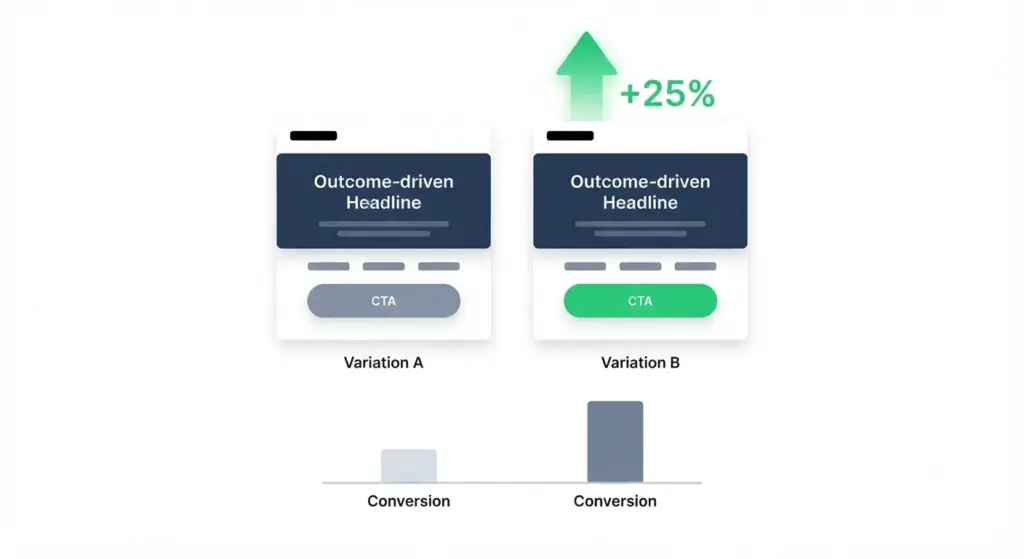
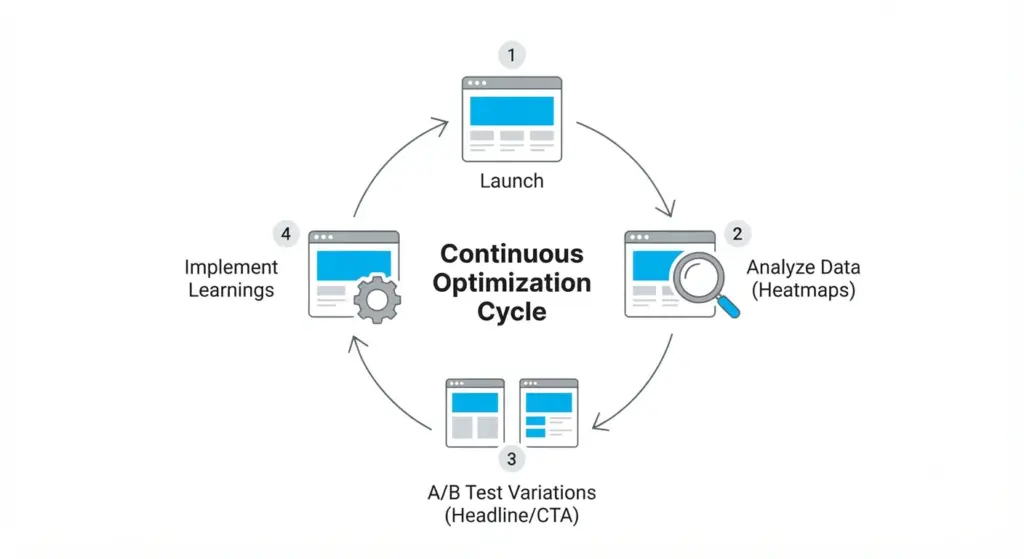
Even the best landing page examples are usually the result of continuous iteration.
Key practices:
- A/B testing headlines and CTAs: Small copy changes can generate surprisingly large conversion uplifts.
- Heatmaps and scroll tracking: Identify sections users ignore, then simplify or reposition them.
- Form optimization: Experiment with field count, labels, and inline validation to reduce friction.
- Ongoing CRO process: Regular audits of funnel performance rather than one‑off redesigns.
This is where your agency can map its own testing methodology and share sample uplift metrics (e.g., “CTA copy test increased clicks by X%”).
SEO Foundations for Landing Pages
While landing pages often focus on paid and direct traffic, SEO still matters for sustainable lead generation.
Essentials:
- Focused keyword targeting: Primary keywords like “best landing page examples” complemented by semantically related terms.
- Clean URL and metadata: Descriptive slug, compelling meta title, and meta description aligned with user intent.
- Structured content:** Logical headings, FAQ schema, and clear, concise copy that satisfies searcher expectations.
- Internal linking strategy: Links from relevant site sections (blog, services pages) to strengthen authority.
Your own performance data (organic traffic growth, ranking improvements) can be used to illustrate the value of SEO‑aware landing page design.
Quick Reference Table: Landing Page Types and Focus
| Landing page type | Primary goal | Most important elements |
|---|---|---|
| SaaS free trial | Start product usage | Outcome headline, simple signup, product visuals, proof |
| B2B service lead gen | Book qualified calls | Single CTA, pain‑solution copy, authority signals |
| E‑commerce product launch | Drive purchases | Story hero, strong imagery, trust near CTA |
| Webinar / event registration | Grow list and attendance | Value‑first copy, agenda bullets, speaker credibility |
| Free resource / download | Build email list | Clear offer, benefit bullets, tuned form |
| Productized service | Sell fixed‑scope engagements | Scope clarity, process steps, transparent pricing |
| “Coming soon” / pre‑launch | Capture early interest | Curiosity headline, simple form, early proof |
You can layer your own real‑world examples into this table to create a portfolio‑driven resource.
FAQ: Best Landing Page Examples (Schema‑Friendly)
Q: What defines the “best landing page examples” for small businesses and tech teams?
A: The best landing page examples for small businesses, CTOs, and e‑commerce managers are pages that align one clear offer with a specific audience, backed by strong proof and a frictionless path to conversion. They combine outcome‑driven messaging, focused CTAs, mobile‑optimized layouts, and measurable performance improvements that tie directly to revenue or qualified lead generation.
Q: How many CTAs should a high‑converting landing page use?
A: High‑performing landing pages typically rely on a single core CTA, repeated multiple times, rather than different actions that compete with each other. Multiple, divergent CTAs (e.g., “Learn more,” “Book a demo,” “Download brochure”) frequently introduce decision fatigue and lower overall conversion rates.
Q: Are long or short landing pages more effective?
A: Both long and short pages can perform well; the deciding factor is whether each section adds clarity, proof, or reassurance for the visitor. Complex, high‑ticket or technical offers often benefit from longer pages with more context and case evidence, while simple, transactional offers usually perform best with concise layouts.
Q: How can I measure whether my landing page is truly effective?
A: Effectiveness is best measured by core funnel metrics such as conversion rate, cost per acquisition, quality of leads, and downstream revenue from visitors who land on the page. Running A/B tests on headlines, CTAs, forms, and layouts, and comparing these metrics over time, reveals whether your landing page is moving toward “best in class” performance.
Q: Can I use templates from the best landing page examples for my business?
A: Yes—templates inspired by leading examples are a strong starting point, provided you adapt them to your audience, offer, and brand voice. The most successful implementations pair proven structures with original content, real case metrics, and ongoing optimization tailored to your specific market.
If you’re ready to move from inspiration to implementation, you can share your current landing pages and target metrics, and our agency can help you turn these best landing page examples into a tailored, data‑driven blueprint for your next high‑converting page.